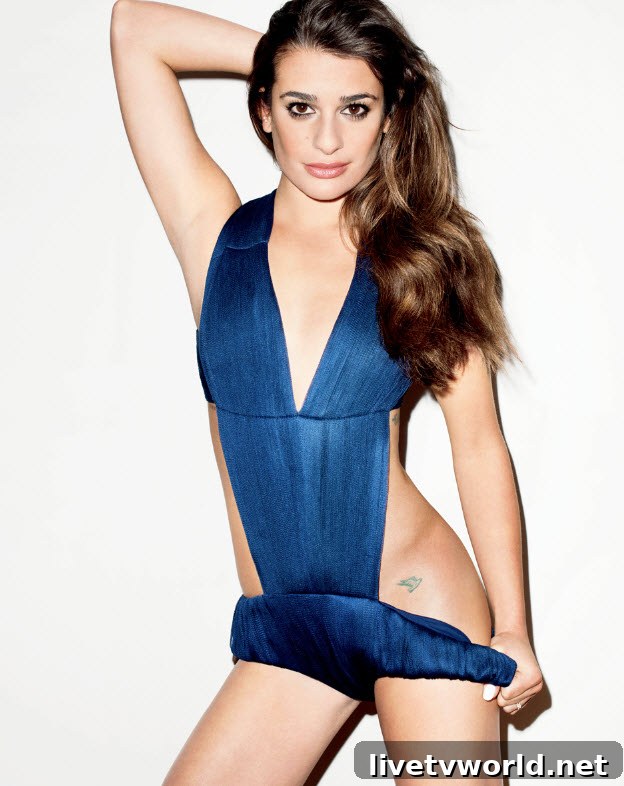
Lea Michele, best known for her role on Glee, surprised fans with a provocative new photo spread by photographer Terry Richardson. The images present a more daring side of the actress and singer, contrasting with the wholesome persona many associate with her public life.
In the V Magazine feature, Lea addressed the contrast herself with a touch of humor. “My friends call me Grandma, but like, Grandma’s killing it right now. I’m pretty sure Grandma nailed it in a half-naked Terry Richardson shoot, okay?” she told the magazine, acknowledging both the surprise and the playfulness of the shoot.
Beyond the images, the V Magazine interview focused on a deeper and more personal subject: the recording of her debut album, Louder, which was scheduled for release on March 4. Lea discussed how creating music has been part of her process of grieving the loss of her boyfriend and Glee co-star, Cory Monteith, who died of a drug overdose in July. The emotional toll of that loss has informed much of her work on the record.
One of the album’s tracks, “If You Say So,” was written as a private tribute to Cory. Lea described it as deeply personal: “It’s the only song that no one’s heard,” she said. “I can’t talk about it until people hear it. It’s just one of those things where I understand what it means and you can take it or leave it. That song is for me.” The track is presented as a private memorial within a public project, underscoring how artists sometimes use their craft to process grief and remembrance.
Lea’s willingness to appear in provocative imagery is not entirely new. Early in Glee’s run, she and some of her co-stars took part in a controversial GQ photoshoot that many saw as a more sexualized presentation of their television characters. That feature drew criticism for its suggestive themes; in its aftermath, co-star Dianna Agron issued an apology on Tumblr. Lea did not follow with an apology, and she has continued to choose projects that sometimes push against the expectations set by her wholesome public image.
Her background also includes stage work where nudity was part of the artistic presentation. While starring on Broadway in Spring Awakening, Lea performed in a production that included nude scenes, a reminder that many performers’ careers encompass a wide range of roles and artistic choices.
Commercially, Lea’s music career has seen mixed results. Her debut single “Cannonball” and a sequence of weekly buzz singles from Louder generated attention but did not dominate the charts. Critical reception has also been varied; Rolling Stone’s review of the album assigned it one and a half stars, a tough critique that reflects the gap that can exist between an actor’s established fan base and the reception of their new creative ventures.
The V Magazine spread and interview highlight the dual narratives that follow Lea Michele: as a public figure whose image can surprise or unsettle, and as an artist coping with personal loss while building a music career. Whether fans respond to the provocative photography, the intimate songwriting, or both, the feature makes clear that Lea is making deliberate artistic choices as she navigates her life and work in the public eye.
The full interview and photo series appear in V Magazine’s coverage of the shoot. For readers following Lea’s evolving career, the combination of candid conversation and striking visuals offers a window into how she balances personal expression, public perception, and creative ambition.